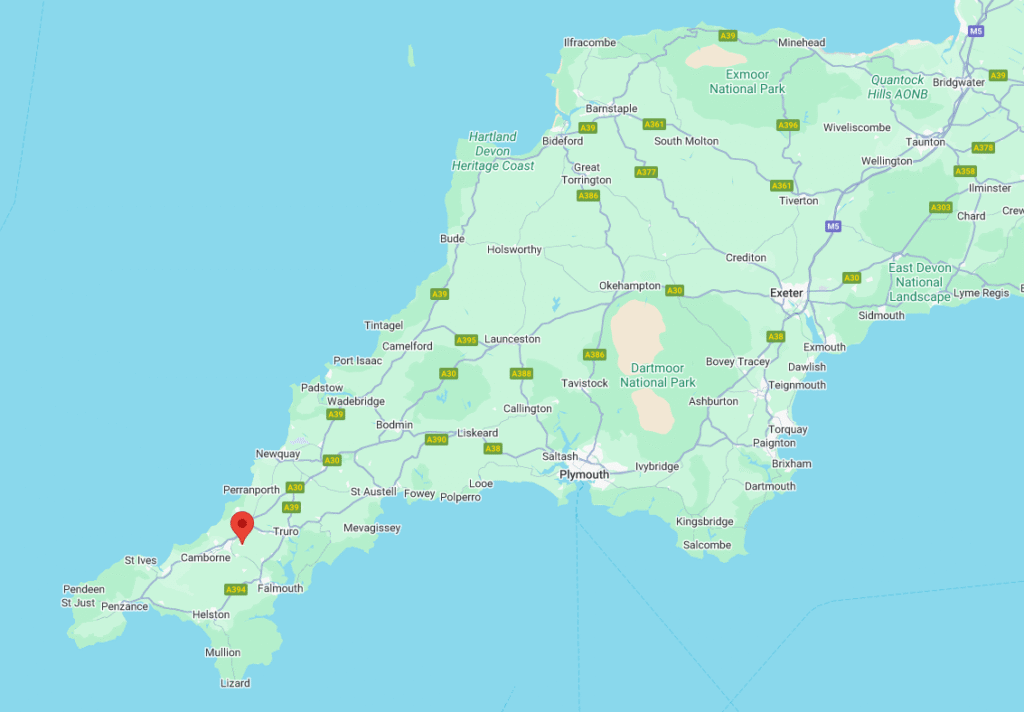
Within the pantheon of legendary Cornish mining districts, few names resonate with the same historical and mineralogical significance as Wheal Gorland. Located in the heart of the St. Day area of Gwennap, once dubbed the “richest square mile in the Old World”, this was primarily a copper mine that operated with great success during the 18th and 19th centuries. While it produced vast quantities of copper ore, its true and lasting fame comes not from what was processed in the smelters, but from the extraordinary treasures that were saved from the crushers. The upper, oxidized zones of its lodes became a mineralogical paradise, a perfect natural laboratory for the formation of rare and beautiful secondary copper arsenate minerals.
Wheal Gorland is, above all, celebrated as the world’s premier locality for a suite of iconic “type locality” minerals. It is the undisputed source of the world’s finest liroconite, producing unrivalled, electric sky-blue crystals that are a holy grail for collectors. It is also the type locality for clinoclase, found in deep, lustrous blue-green crystals of exceptional quality. The list of its contributions to science is astonishing, with other species like chalcophyllite, chenevixite, and the aptly named cornwallite all first being identified from specimens found within its workings.
Today, with the mine having closed well over a century ago, every surviving specimen from Wheal Gorland is a precious historical artefact. These minerals are not just beautiful objects; they are tangible links to the golden age of Cornish mining and the very birth of mineralogy as a formal science. Found in the collections of every major natural history museum and cherished by discerning collectors, a fine Wheal Gorland piece represents the absolute pinnacle of classic European mineralogy, a rare and irreplaceable piece of the Earth’s history.